
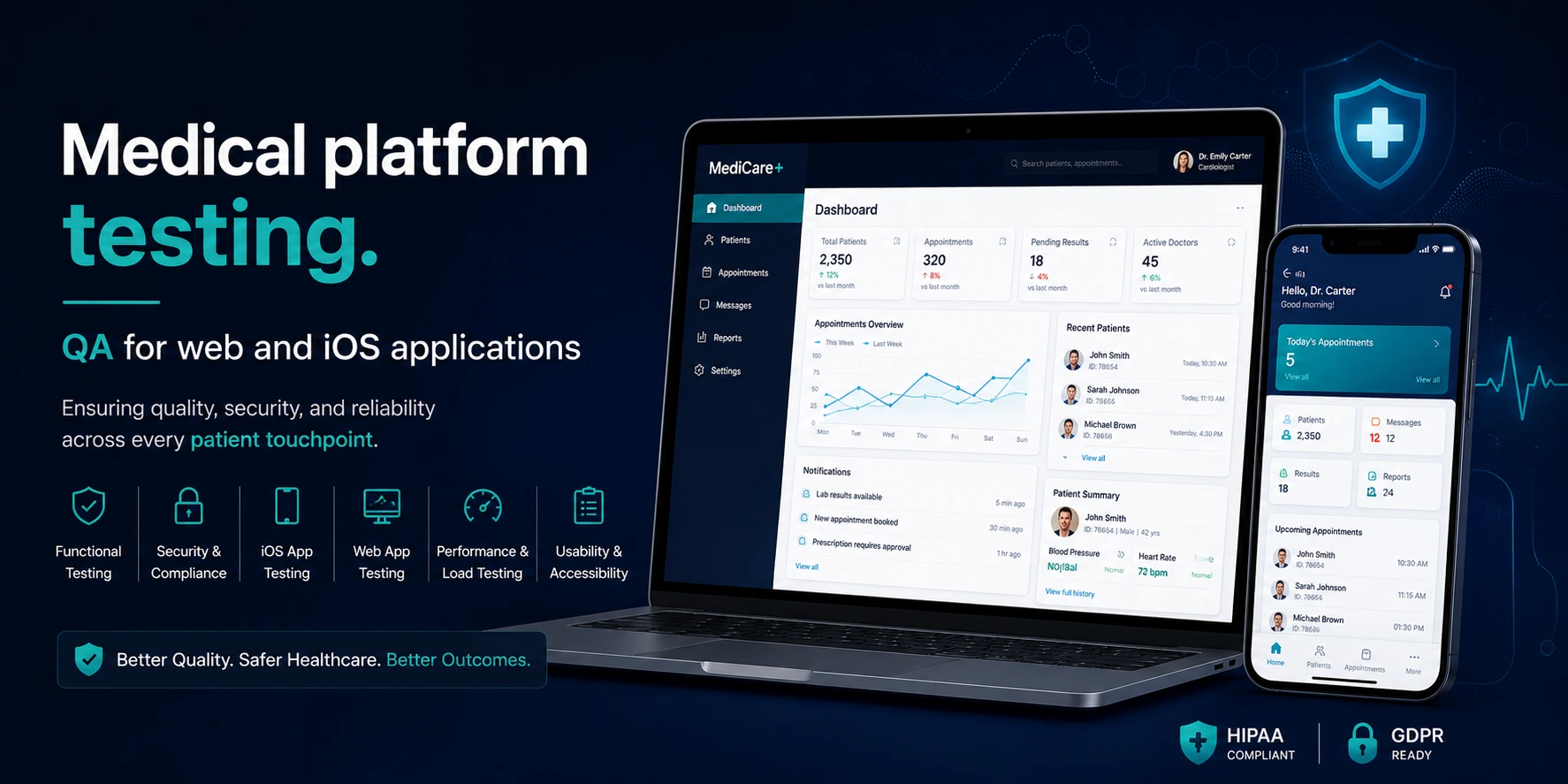
QA for a Medical Brain Activity Analysis Platform
- Industry
- Healthcare
- Services
- Manual Testing, API Testing, QA Audit
- Platform
- Web, Mobile
- Client
- US Healthcare Technology Company
Challenge
A US-based medical platform analyses brain activity data from specialist hardware devices and generates diagnostic reports for physicians. The platform runs as both a web application and an iOS app — both used in clinical settings where data accuracy and reliability are non-negotiable.
When we joined, the QA function was a single tester doing manual checks only. Test documentation existed only for already-delivered features, making it impossible to assess real coverage or prevent regressions when new functionality shipped. Automation was completely absent. The bug-fixing process was unstructured, with no systematic defect tracking.
For a platform that doctors rely on for diagnosis and treatment decisions, this was a serious risk.
Solution
We provided one QA automation engineer. The brief: high-quality coverage across web and iOS, early defect detection, and a foundation for automation.
Building the QA foundation
- Developed 400+ test cases covering functional, regression, and exploratory scenarios
- Introduced test case management to systematise coverage and enable tracking over time
- Formalised the defect lifecycle — structured reporting, clear priorities, blocking/critical bug flagging
- Developed a cross-platform testing strategy covering both web and iOS to a consistent standard
Manual and API testing
- Conducted thorough functional, regression, smoke, and exploratory testing across both platforms
- Manual API testing via Postman and Swagger — verifying all endpoints and integration documentation
- Configured Postman Flows to automate repetitive API testing scenarios
- UI/UX and accessibility testing on both web and iOS builds
- Cross-platform testing across devices and browsers via BrowserStack
Reporting and process transparency
- Daily testing reports during active cycles
- Final regression reports before each release
- Full defect reports with descriptions, priorities, and reproduction steps
- Zephyr analytics integrated with Jira for defect tracking across the team
- PDF summary reports for stakeholders
Automation groundwork
- Identified key scenarios for future automation
- Configured a framework, reporting pipeline, and CI/CD integration via GitLab
- Initial automation deployed — coverage growing with each sprint
Tools used: Postman, Swagger, Zephyr, Jira, Webdriver.io, Appium, Allure, BrowserStack, GitLab, VS Code
Results
A medical platform with minimal QA discipline became one with structured, traceable, continuously improving quality processes:
- 4–5× reduction in bugs reaching production — measurably safer releases for clinical users
- 226 defects identified and fixed before release — errors resolved before they reached doctors
- 400+ test cases developed from scratch — all key clinical scenarios documented and repeatable
- Cross-platform coverage established across web and iOS
- Full defect visibility for development team — blocking issues escalated immediately
- Automation framework in place and growing — manual testing share decreasing sprint by sprint
More results
Related case studies

Get started
Ready to see results like these?
Start with a free 60-hour trial — no long-term commitment, just real QA on your actual project.